
On page and Off page SEO: Tips for SEO Success Today
If you want predictable organic traffic, you need to get on page and off page seo working together. I’ve found that most SEO wins come from nailing the basics on your site first, then earning authority and trust from credible sources off your site.
In practice, SEO is usually a mix of:
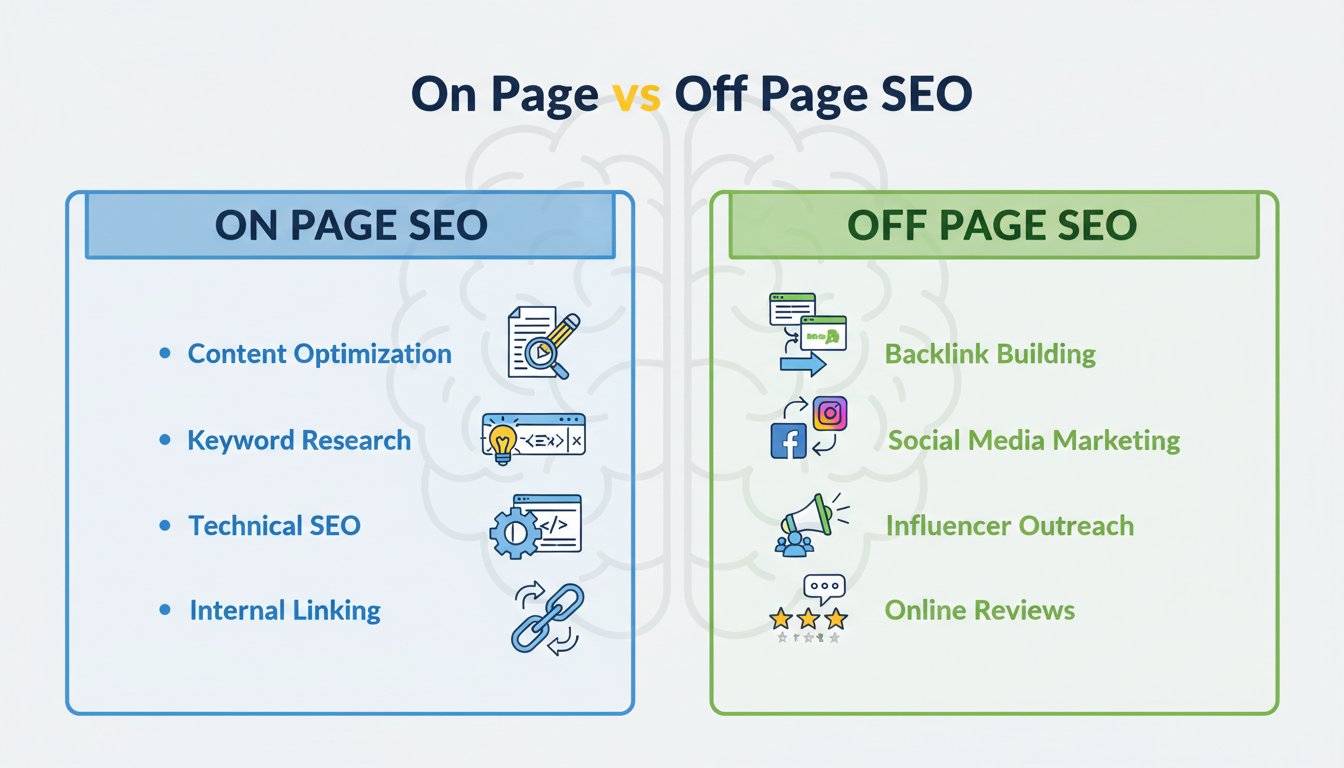
On-page SEO (on-site SEO): what you improve on your pages (content, headings, internal links, image alt text, etc.).
Off-page SEO (off-site SEO): what builds your site’s authority and trust across the web (backlinks, brand mentions, reviews, digital PR, etc.).
Technical SEO: the foundation that helps pages get crawled, indexed, and perform well (speed, mobile, site architecture, structured data, and more).
This guide explains on page and off page seo, breaks down on page vs off page seo, and shares practical examples you can apply—while keeping content quality aligned with E-E-A-T (Experience, Expertise, Authoritativeness, Trustworthiness).
Understanding On-Page and Off-Page SEO (on page and off page seo)
On-page SEO helps search engines and users understand what a page is about and whether it satisfies search intent. It includes content optimization, keyword placement, internal linking, and UX-focused formatting.
Off-page SEO helps search engines evaluate whether your site is reputable. It’s strongly influenced by your backlink profile, brand reputation, and other trust signals across the web.
On-page vs off-page SEO (quick comparison)
Area On-page SEO Off-page SEO
Where it happens On your website Across other websites/platforms Main goal Relevance + usability Authority + trust Core signals Content quality, headings, internal links, metadata, topical coverage Quality backlinks, brand mentions, reviews, citations, digital PR What you control Mostly Indirectly (you influence it by earning attention)
E-E-A-T and content quality: how it connects to on-page and off-page SEO
Google’s documentation emphasizes that helpful, people-first content should demonstrate strong E-E-A-T:
Experience: first-hand usage, real examples, screenshots, original photos, or clear “how we did it” steps.
Expertise: accurate explanations, correct terminology, and depth that matches the query.
Authoritativeness: recognition from others (mentions, links, citations) and clear credentials where relevant.
Trustworthiness: transparent authorship, sources/references when you quote claims, updated information, secure site, and clear contact details.
When I plan content, I use on-page SEO to demonstrate experience and expertise (clear structure, accurate explanations, and step-by-step guidance). Then I treat off-page SEO as the evidence layer—earning mentions and links from reputable sources to build authority.
If you want the most direct references, start with Google Search Central’s guidance (SEO Starter Guide) and the Spam Policies for Google Web Search. For E-E-A-T context, the Search Quality Rater Guidelines (PDF) are the clearest reference.
On Page SEO: key elements and best practices
On-page SEO covers content, HTML elements, and page-level UX. It’s also where you naturally include related terms (often called LSI keywords), such as on-site optimization, content SEO, internal linking, search intent, and technical on-page factors.
Title tags, meta descriptions, and headers
Title tags help search engines understand the topic and help users decide whether to click. I aim for clarity first, then I work in the keyword naturally.
Meta descriptions aren’t a direct ranking factor, but a clear description can improve click-through rate by setting expectations.
Header tags (H1/H2/H3) create structure for users and help search engines parse your topical coverage.
Practical tip: use one clear H1, then H2s for major sections, and H3s for subpoints (for example, H2 “On-page SEO checklist” and H3 “image alt text”).
Content quality + keyword optimization (without keyword stuffing)
For content that’s easy to read and credible, I focus on intent and completeness—not repetition.
Write to a specific search intent (informational, transactional, local, etc.).
Use the primary phrase (like on page and off page seo) naturally in the introduction and one key subheading—then prioritize clarity.
Add related terms where they fit: backlink quality, link profile, anchor text, content optimization, technical SEO, local SEO citations, Google Business Profile, brand signals.
Strengthen trustworthiness with concrete steps and references (especially for policy or technical claims).
How I use commercial-intent keywords (without sounding salesy)
If I’m targeting buyers (not just readers), I mix informational coverage with commercial-intent phrasing naturally, such as SEO services, hire an SEO expert, SEO agency, local SEO services, technical SEO audit, and SEO packages. The goal is still to be helpful—for example, I’ll explain what to look for in an agency proposal (deliverables, timelines, and reporting).
Real-world example (E-E-A-T on-page): When I write (or review) an SEO audit page, I include a “What I check first” section and list the exact items I verify (indexability, duplicate titles, internal links, Core Web Vitals). This shows experience and keeps the advice grounded.
Internal linking and topical coverage
Internal links help distribute authority across your site and help Google discover related pages. They also improve UX by guiding users to the next best step.
Link from high-traffic pages to important service/product pages.
Use descriptive anchor text (avoid “click here”).
Build topic clusters (pillar page + supporting pages) to demonstrate depth and expertise.
Internal link idea (commercial intent): If you’re evaluating search engine optimization services, link relevant blog guides (like this one) to your service page so readers can take the next step when they’re ready.
Technical on-page SEO: mobile, speed, and UX
Even great content can underperform if pages are slow or frustrating to use.
Mobile-first: ensure layouts, fonts, and buttons work well on mobile.
Page speed: compress images, reduce heavy scripts, and use caching/CDN where appropriate.
UX signals: clear navigation, readable formatting, and minimal intrusive popups.
To validate speed issues, I typically start with PageSpeed Insights and then confirm in real browsers/dev tools before making changes.
Off Page SEO: building authority and trust
Off-page SEO is about earning confidence signals from other reputable entities online. The most well-known signal is backlinks, but modern off-page SEO also includes brand mentions, reviews, local citations, and digital PR.
Link building strategies that align with quality guidelines
In my workflow, safe link building means I can explain the value of the link to a real person—not just a search engine.
Digital PR: pitch stories, insights, or data to relevant publications.
Resource outreach: earn links from “best tools/resources” pages by offering something unique.
Partner mentions: suppliers, clients, associations, and events can be legitimate sources of citations and links.
Avoid: paid link schemes, private blog networks (PBNs), and spammy directory blasts.
For official guidance on what to avoid, I refer to Google’s link spam policies (link spam section).
Brand mentions, reviews, and local SEO citations (important in India)
If you serve local customers, off-page SEO includes reviews and consistent NAP citations (Name, Address, Phone) across platforms.
Keep your Google Business Profile complete and up to date.
Earn and respond to reviews professionally.
Ensure consistent business details across relevant local directories (only where it makes sense for your industry).
Real-world example (local off-page SEO): I’ve seen clinics struggle in the local pack when their address or phone differs across listings. Standardizing NAP details, improving Google Business Profile categories, and earning recent reviews usually leads to better visibility for “near me” and area-based searches.
Off-page SEO and E-E-A-T (how I think about authority)
Publish assets that are worth citing: original frameworks, checklists, templates, or first-hand insights.
Show who is behind the content: author bios, editorial policy, and a clear way to contact you.
Earn mentions from relevant, credible sites (industry associations, reputable publications, respected niche blogs).
Mini case studies (realistic, what works in practice)
These examples focus on actions and outcomes you can verify in your own analytics (instead of relying on generic claims).
Case study 1: Service business page that wasn’t converting (on-page + UX)
Problem: The page ranked for broad terms but didn’t match intent (users wanted pricing, service area, and next steps).
On-page fixes: rewrote the H1/H2 structure, added a clear service-area section, added FAQs, improved internal links from blog posts to the service page, and added clearer calls-to-action.
Why it supports E-E-A-T: transparent service details + FAQs demonstrate experience and reduce ambiguity.
Case study 2: Ecommerce category page stuck on page 2 (topical coverage + internal links)
Problem: A category page targeted a competitive keyword but had thin copy and few internal links.
On-page fixes: added a short buying guide, clarified filters, improved structured data where applicable, and added internal links from relevant blog content (how to choose, size guide, care tips).
Off-page support: pitched a seasonal guide to relevant publications and creators to earn natural mentions.
Case study 3: Link building without “link bait” (digital PR + genuine expertise)
Problem: Content was decent but no one referenced it.
What worked: publishing a small, original dataset (for example, a customer survey or internal trend snapshot), explaining methodology, then reaching out to journalists/bloggers in that niche.
Why it supports trustworthiness: methodology + limitations reduce exaggeration and make coverage easier.
Actionable checklist: what to do this week
On-page SEO checklist
Confirm one primary intent per page (what should the user accomplish?).
Improve title tag + H1 clarity; align with search intent.
Add related terms naturally to improve topical coverage.
Strengthen internal linking (pillar page + supporting pages).
Check mobile usability and page speed (especially images).
Add trust elements: author info, last updated date, and references where needed.
Off-page SEO checklist
Audit your backlink profile for obvious spam risks.
List 10–20 realistic link/mention opportunities (partners, associations, local publications).
Improve Google Business Profile (if local): categories, services, photos, and review process.
Build a simple digital PR angle: a guide, template, or data insight worth citing.
Conclusion: integrating on-page and off-page SEO for long-term results
On-page SEO helps you earn relevance and provide a great experience. Off-page SEO helps you earn authority and trust. When you combine both—and back them with E-E-A-T signals like first-hand experience, accurate information, and transparent authorship—you build a strategy designed for long-term search visibility.
If you’re ready to turn this into a plan with deliverables (audit, on-page fixes, and ongoing link-worthy content), you can start here: SEO services.
FAQ
1. what is the difference between on page and off page seo
Answer: On-page SEO is everything I optimize on a website to improve relevance and usability (content, titles, headings, internal links, image alt text, and UX). Off-page SEO is what happens outside the site to build authority and trust (quality backlinks, brand mentions, reviews, local citations, and digital PR). On-page is direct control; off-page is influence through earned attention and coverage.
2. what are the best techniques for off page seo
Answer: I focus on quality, relevance, and trust signals:
Earn high-quality backlinks: digital PR, expert quotes, publishing cite-worthy guides/templates, and legitimate partner/association mentions.
Resource outreach: get included on relevant resources/tools pages when you have something genuinely useful.
Brand building: consistent brand mentions across reputable sites and communities in your niche.
Reviews and reputation: encourage and respond to reviews (especially important for local SEO).
Local citations (NAP consistency): keep Name, Address, Phone consistent across key listings if you serve a local area.
3. Is on-page SEO more important than off-page SEO?
Answer: They work together. I usually prioritize on-page SEO (and technical SEO) first because search engines need to crawl, index, and understand your content before authority can help it rank. As competition increases, off-page SEO becomes more important because strong, relevant links and brand trust help you stand out. The practical approach is to fix fundamentals on-page, then build authority off-page in parallel.